-
The Anthropocene
This week we discuss the impact of the Anthropocene, as well as US Environmentalism historically. Throughout history, there have been 5 types of human societies globally, hunter-gatherer, agricultural, mercantile capitalist, industrial capitalist, and consumer capitalist. The first humans we believe had an impact on the environment were the indigenous people, or the hunter-gatherers. These communities lived low-impact lifestyles, they did not engage in transcontinental shipping and were largely homogenous before the arrival of Europeans around 1493. With the arrival of European settlers as well as African people brought to the Americas to do forced labor, a host of new pathogens were introduced to the continent, killing over half of the indigenous population. It is estimated that 70% of the people who were in contact with Europeans died, due to disease.
The colonization of the Americas did allow for more people to live off of the land and was considered one of the largest agricultural improvements since the original agricultural revolution. Pathogens and disease were not the only new lifeforms the Europeans spread to the Americas and across the world. Once the period of the Colombian exchange began, the homogenization of plant and animal species across the world began as well. This is why we see many of the same animals and plants no matter where we are in the world. An example of this is the Italian Oxford Ragwort, which is a species of daisy originally from Italy. The plant stowed away on ships during the Colombian exchange period and hybridized with native species so that it could survive. Because these new hybridize species had no natural enemies, they often overran their new environments.
Transatlantic shipping worked backward in a way, undoing what Pangea had done over 200 million years ago. Before international trade and colonization began, each continent was thriving individually, each with unique plant and animal species. In fact, before the Colombian exchange began, humans’ geological location could be identified by examining the different ratios of the isotopes in Strontium, an element present in human teeth and bones. This is because each continent had a unique chemical signature of Strontium in its soil. The conquest of the Americas brought a lot of wealth to Europe, especially Spain, and linked Western Europe with China and the Americas in a global trade system for the first time in history. Because all of the wealth derived from farming in the Americas went back to Europe, they relied on slave labor, and there was no regard for how people or the environment were treated. As Lewis and Masin write in their book The Human Planet, How We Created the Anthropocene “ “The logical endpoint of reducing people to economic units and reducing costs as far as possible was the inhumanity of slavery” (page 137).
Amidst this sudden trend of mercantile capitalism, humans began to search for more energy sources to power their businesses. Britain was the first to begin manufacturing steam engines during the industrial revolution, which were somewhat environmentally friendly, as they did not burn any fossil fuels like the use of coal would. Factories were fully functional using water mills as an energy source, as well as the Newcomen engines, which pulled up about 2000 liters of water per minute from deep water wells. Many factory owners decided to make the switch to coal-powered engines following a moral outrage about child labor laws and worker’s rights, as it was often children working long 69 hour weeks at the watermills. At the same time, the idea of the abolition of slavery was beginning to gain traction in the Americas. Once this occurred, farm and factory owners alike decided it would be more economically effective to not only switch to the use of fossil fuels but to pay workers minimum wage rather than continue with slavery. There were many negative environmental consequences, one of which was the release of CO2 into the atmosphere through the burning of fossil fuels. CO2 levels rose from approximately 280 to 404 ppm during the industrial revolution, far greater than the amount of CO2 released in the period between the final glacial maximum and end of the Holocene. Most of this excess CO2 dissolves into the ocean’s surface, causing an acidic environment for marine life. This leads to slowed growth rates and misshapen shells among many species. Once this industrial revolution began the population increased globally, leading to a few unforeseen issues. For one, the Great Stink occurred in London, where overpopulation had backed up the city’s human waste management system, and the streets began to flood with sewage. Their solution to this problem was to set up 1,100 miles of street sewers, which would carry London’s waste away from the city to be dumped, untreated, into the river Thames. Several other cities around the world took influence from London in doing this. Eventually, laws were put in place and organizations came around to prevent environmental harm to a certain extent. For example, the Coal Smoke Abatement Society required ash and soot particles to be filed under the clean air laws. This only occurred after the Great London Smog killed early 8,000 people.
Although Anthropocence refers to the impact that all humans have had on the environment over time, not all people have the ability to make the same impact, positive or negative. There are many who can afford to be environmentally conscious by doing things like following a vegan diet or installing solar panels, but there are ways for everyone to reduce their carbon footprint. Simple tasks like turning off the lights when leaving a room, or taking public transportation rather than driving can greatly reduce the amount of CO2 in the atmosphere.
Word count:
951
Works Cited “Globalization 1.0,” “Fossil Fuels, the Second Energy Revolution,” and “How We Became a Force of Nature,” The Human Planet, Simon L Lewis and Mark A Maslin, pp. 149-225, 329-365.
-
Ecological Footprints and a Warning to Humanity
An ecological footprint can be defined as a rough estimate of one’s total environmental impact, through the use of transportation, energy sources, consumption of meat and processed foods, and more. Measuring my ecological footprint proved to be shocking, as my personal Earth overshoot was just April 11th. If everyone in the world lived this way we would need 3.6 Earths to sustain ourselves, and I consider myself environmentally conscious. According to environmentalists, the most developed countries use upwards of 70% of the Earth’s natural resources despite being home to only 17% of the world’s population. The United States alone is using an estimated 30% of these resources. The excessive consumption of both renewable and nonrenewable resources in wealthy countries has led to pollution of the air and water, as well as extreme weather and rising ocean levels. But it will not be just the environmentally non-conscious nations that will be affected; once the world’s ecosystems are irreversibly damaged no nation will escape its downfall. We are often given the narrative that we need to save the Earth, that the Earth is dying, but it is not the Earth that’s in danger of extinction. Earth has survived for 4.5 billion years and will survive to repair itself from the destruction humans have caused. We are what is in danger of extinction. G. Tyler Miller and Scott E. Spoolman of Living in The Environment write “According to environmental ethicists, we have a responsibility to leave the planet’s life-support systems in a condition as good or better than what we inherited for future generations and for other species” (Miller and Spoolman, page 8). I agree with this point, if we are going to continue to populate the Earth we have a moral responsibility to ensure that it will be habitable for the next few hundreds or thousands of years. An alternate solution would be to cut back on population growth through intensive family planning organizations and the freedom for women globally to make reproductive decisions. An article from Bioscience titled “World Scientists’ Warning of a Climate Emergency” reads “These policies make family-planning services available to all people, remove barriers to their access and achieve full gender equity, including primary and secondary education as a global norm for all, especially girls and young women.” (BioScience, Volume 70, Issue 1, January 2020, Pages 8–12). Right now, about one fifth of the world is livign in absolute poverty, meaning they do not have enough to eat and another percent of those are facing malnutrition. Everyone deserves to have enough clean food and water regardless of age, gender, race, or income or what part of the world they are living in. A slow of population growth would decrease competion for the resources of food and clean water, and hopefully help with this issue.
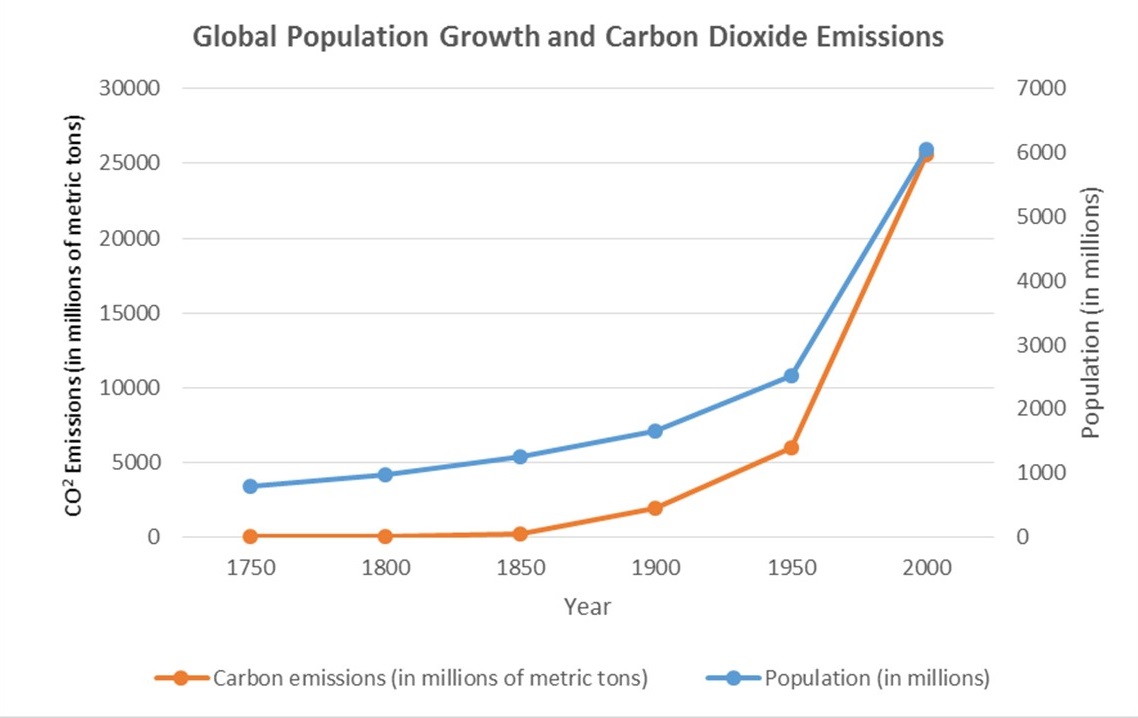
Figure 1 This graph depicts the metric tons of carbon emissions globally, and how they’ve increased with the population. In the United States, the average price per metric ton of CO2 was just $15.25.
What Can Be Done?
Although the human effects on the environment are evident and deeply troubling, some steps can be taken to reduce our ecological footprints, both personally and as a whole. Miller and Spoolman write “If the total ecological footprint is larger than its biocapacity, the area is said to have an ecological deficit. Such a deficit occurs when people are living unsustainably by depleting natural capital instead of living off the renewable resources and ecosystem services provided by such capital” (Miller and Spoolman, page 11). I found that the most interesting and likely most effective way for humans to cut back on nonrenewable resources such as oil and gas, as well as metallic mineral sources is to pool less of them into war and preparing for war. According to the World Scientists’ Warning to Humanity which was signed by 1700 scientists in 71 countries, about one trillion dollars worth of resources are dedicated to this. By promoting peace we are promoting a healthier planet that can provide for the generations to come. We can also make sure that we are protecting the Earth’s resources by recycling, driving less or carpooling to reduce greenhouse gases and eating sustainably farmed local foods.
Discussion Questions:
Is it the responsibility of more developed nations to reuce their ecological footprints and use of resources so that less developed countries can use what they need without having to worry about the environmental impact?
Word Count: 740
Works Cited:
Miller, G. Tyler and Scott Spoolman. Living in the Environment. Cengage Learning Asia Pte Ltd, 2021
World Scientists’ Warning to Humanity, Union of Concerned Scinetists (UCS), April 1997
Figure 1. : How does Population Growth impact Climate Change? Katie Luoma | November 1, 2016, https://populationeducation.org/how-does-population-growth-impact-climate-change/
BioScience, Volume 70, Issue 1, January 2020, Pages 8–12, 05 November 2019 https://doi.org/10.1093/biosci/biz088
-
Subscribe
Subscribed
Already have a WordPress.com account? Log in now.
 Environmental Studies Blog